
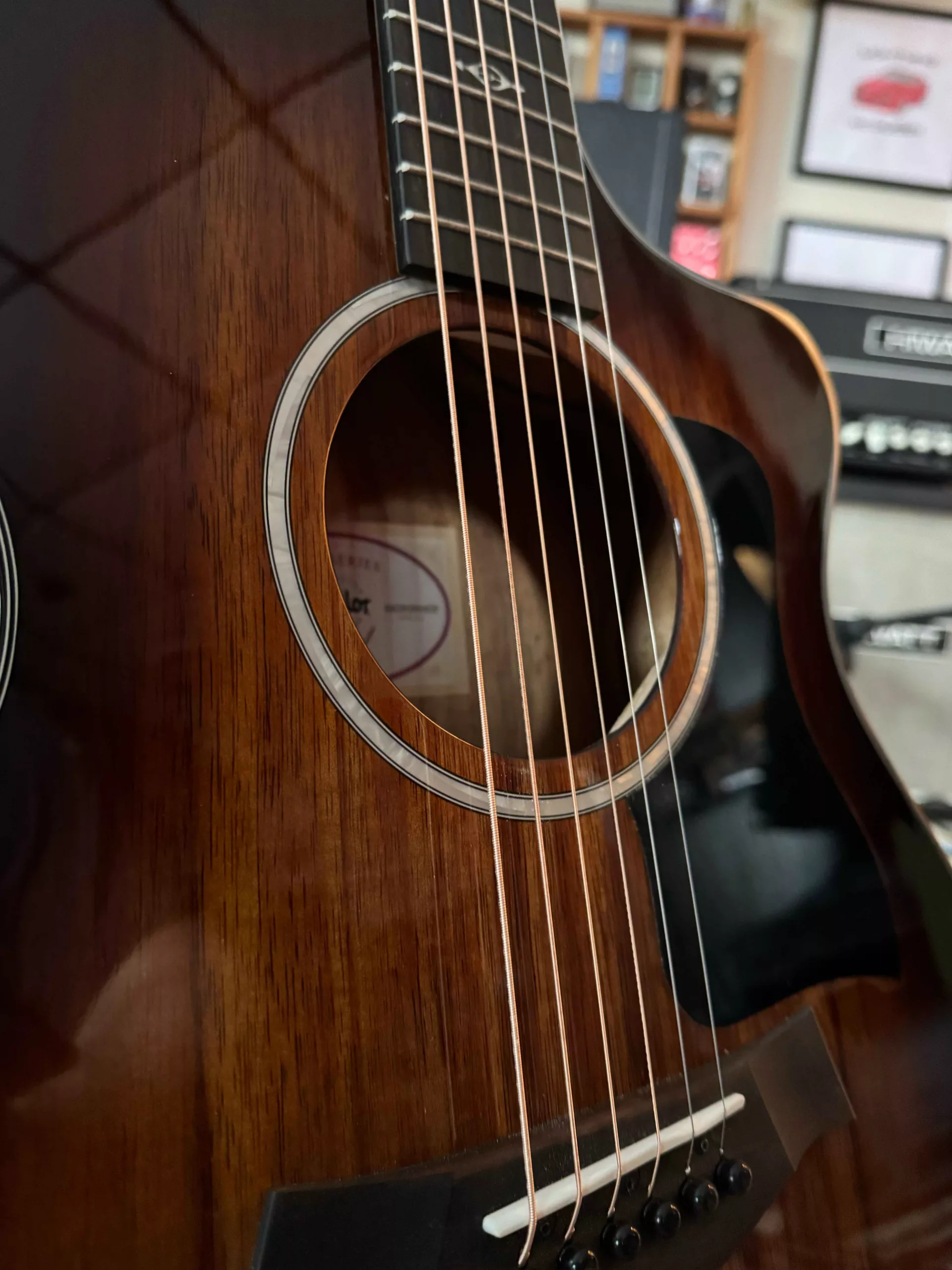
There are some guitars you buy with your head, and some that haunt you from the moment you walk away. My Taylor 222ce-DLX Koa was the latter, the guitar I almost bought, didn’t, and then couldn’t stop thinking about. The Taylor 222ce-DLX koa experience we’ll call it.
A few weeks back, I set out to replace a Takamine I’d sold in late summer, one of those sales that leaves a bit of seller’s remorse in its wake. While killing time at Guitar Center as my wife had tea with her mom, my attention landed on two guitars: a Martin GPC-16E and a used Taylor 222ce-DLX dressed in a warm tobacco-burst finish over richly figured Hawaiian koa, framed with binding and inlay, and capped with gold tuning machines.
The Martin won out in the moment. Plain-Jane by comparison, its appeal was all in the essentials: tone, feel, and that unmistakable Martin voice and volume. I fell for it immediately. Loved it, bought it on the spot, and brought it home.
But that Taylor never really left my mind.
The Pull of Hawaiian Koa
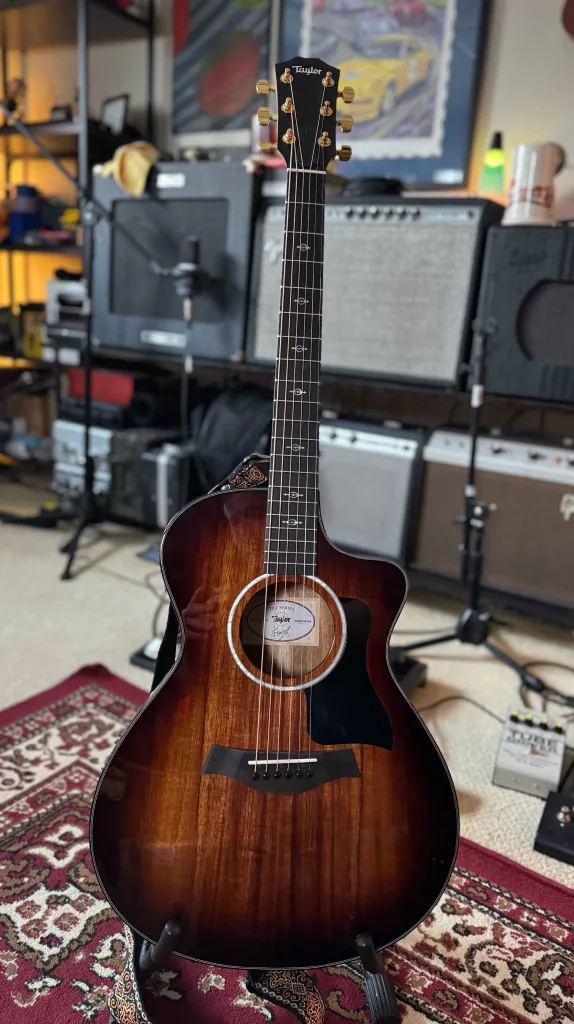
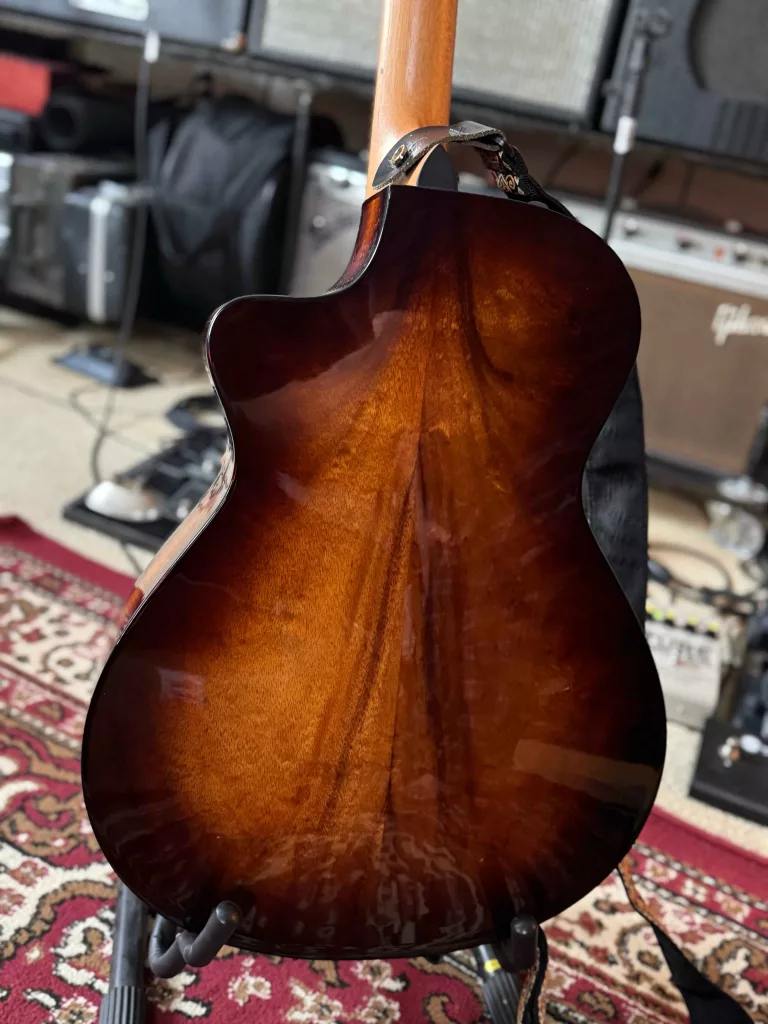
There was something magnetic about that guitar. The koa on the 222ce-DLX had a grain pattern that immediately grabbed me, dark, complex, and impossible to ignore. The back of that guitar had one of the most gorgeous patterns I’ve ever seen. Koa has this rare combination of elegance and wildness, and this particular guitar had both in spades. Even at rest, it felt like it had a story.
Tone-wise, the Taylor couldn’t be more different from the Martin. The Martin is a solid spruce top with rosewood back and sides, while the Taylor 222ce-DLX pairs a solid koa top with layered koa back and sides. After a few weeks of bonding with the GPC-16E’s fullness and projection, the Taylor felt softer, quieter, more intimate. Its Grand Concert body gives it a softer voice; gentle, articulate, and warm rather than bold and booming.
It’s the kind of guitar you pick up when you want to play for yourself, not the room.
And that contrast, I realized, was exactly why I needed it.
Going Back for the One That Got Away
Let me be clear, I didn’t go back because the Martin let me down. I went back because the Taylor wouldn’t leave me alone. The Martin was the right choice, I just wasn’t finished with that koa guitar. I bought it online one morning so it wouldn’t be sold out from under me. Later that day, I went to the store to pick it up. And the moment I picked the Taylor up again, it confirmed what had been nagging at me all along. It was every bit as good as I remembered, maybe even more so.
I bought it without hesitation.
Or at least, I tried to.
The Missing Case Problem
And this is where the experience really started to shift, and sour. Guitar Center lost the case. Not “misplaced temporarily,” not lost in the shuffle. Lost. Just… gone.
At the time, the figuring of the wood, the rich tobacco finish, the binding, the neck, everything that made this guitar pop, made the missing case feel like less of a deal than it became. What should’ve been a detail I shrugged off instead became a weight, quietly attached to the instrument from the very beginning.
I should’ve returned it instantly.
Once I got home, there was this knot in my stomach that wouldn’t go away. Not anger, more like the dull feeling that something wasn’t right. I felt cheated. What should’ve been that first-night excitement with a new guitar turned into me picking up the phone to ask for money off, just to account for a missing case.
That process took several days and more follow-up phone calls than it ever should have. Each time I called my local store, it felt like starting over, explaining who I was, which guitar I’d bought, and why I was calling again. Square peg through a round corporate hole.
It wasn’t great.
If there’s an issue and it doesn’t match the Guitar Center model, forget it. It also wasn’t about anyone being rude or incompetent. It was about friction, too many steps. Too much re-explaining. Too little forward motion. What usually is a painless, straightforward Guitar Center experience turned into something oddly disjointed and impersonal.
And that’s what made it a shit experience.
Not catastrophic. Not dramatic. Just disappointing in a way that slowly wears you down. Instead of settling in with a new guitar, I was managing a problem. Instead of feeling excited, I felt stuck, waiting for callbacks, following up, trying to force a simple solution through a system that didn’t want to bend.
Worse, that frustration started bleeding in the wrong direction. The Guitar Center experience kicked Taylor down a notch in my head, even though I knew, logically, this wasn’t on Taylor at all. I actually had to stop and remind myself of that.
That disconnect mattered. It changed how I felt every time I picked the guitar up. And once the experience surrounding an instrument starts to outweigh the joy of playing it, something’s off.
That was the moment I realized I needed to step outside the Guitar Center bubble entirely.
So I picked up the phone and called Taylor.
A Very Different Conversation
That conversation couldn’t have been more different.
I knew this wasn’t on Taylor but hoped they’d listen. Taylor’s customer service didn’t rush me, didn’t deflect, and didn’t hide behind policy. They listened, they asked questions, and they checked internally to see what they could do on their end. You could tell they were actually trying to help, not just close a ticket or move on to the next call.
And somewhere in that conversation, the idea of returning the guitar came into focus, not as a loss but as the right move.
Once we started talking about value and long-term ownership, it became clear that returning the used guitar and putting that money toward a brand-new version made far more sense. For a few hundred more, I’d not only be starting fresh, but I’d also have the full backing of Taylor’s warranty, including coverage for things like neck resets down the road.
That part mattered.
Knowing that if something ever went sideways again, I wouldn’t be stuck trying to force another square peg through a round corporate hole, that I’d have Taylor directly in my corner, changed how I looked at the entire situation.
Taylor reinforced why I’ve always respected them. The return wasn’t about walking away from the instrument; it was about choosing the smarter, more supported path forward.
No Hard Feelings Toward the Guitar
The Taylor itself? Still incredible, still beautiful, and still exactly the guitar that pulled me back into the store in the first place.
But sometimes timing, context, and experience matter just as much as tonewood and specs. As much as I wanted this to be a “meant to be” guitar, it started to feel like the right instrument showing up at the wrong moment.
Returning it wasn’t a rejection of Taylor; if anything, it was the opposite. That conversation with their customer service reminded me why I’ve always held them in such high regard. When I eventually bring another Taylor home, and I will, it’ll be under better circumstances, without frustration attached to it.
The returned koa Taylor ended up teaching me something I didn’t expect. Not about wood, or tone, or specs, but about how much the experience matters. About how the story surrounding an instrument can shape the way we connect with it just as much as the way it sounds or feels in our hands.
This story didn’t end when I walked out of the shop. Later, the guitar and its case found their way back.