The Obsession
I went to N Stuff Music to drop off my Ibanez RGEW521FM (easy name to remember, huh?) for a pickup swap. The stock pickups were far too shreddy for what I do. I can’t shred. I’ll never be that skilled. But the flat, thin neck is perfect for short guy stubby fingers, so the guitar stayed and the pickups were going. Simple errand. In and out.
I knew they carried Novo. And then I saw it.
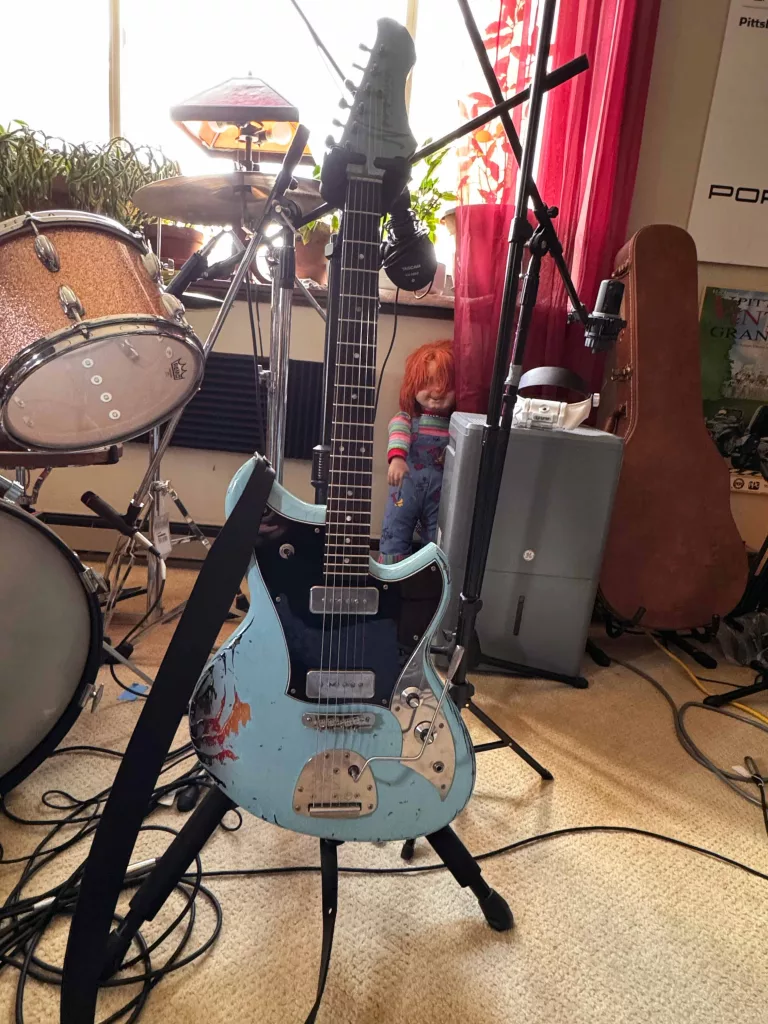
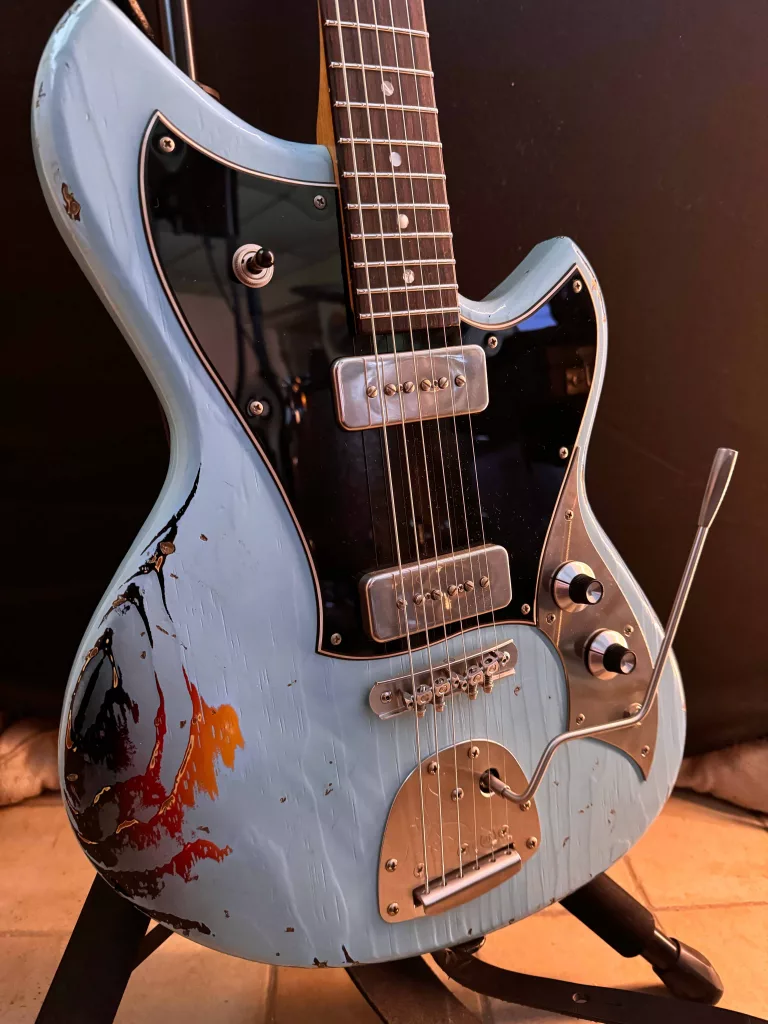
The Novo Serus J LTD in Daphne Blue over a ’64 3-Tone Burst. Hanging there like it had been waiting. Daphne Blue over a sunburst underneath, so that as the nitro finish ages and thins, the burst bleeds through. A limited finish. A one-time thing. I knew what it was, and I walked out without it and told myself I didn’t need it.
That was the beginning of a conversation I couldn’t stop having with myself.
I should back up a little. No, I hadn’t walked in there completely cold. I watched Rhett Shull on YouTube, and if you follow him at all, you know about his Novo Serus J. He talks about how he got it, how it changed his playing, and the way it became the guitar he reaches for without thinking. I’d heard all of it. I knew what Novo was, knew what the Serus J was, and had seen it on a screen plenty of times. But I’d never seen one in person until I walked into N Stuff that day to drop off my Ibanez. There’s a difference between knowing about a guitar and standing in front of one.
Do I Actually Need It?
Here’s the thing about having a large collection: at some point, the honest answer to “do you need this?” is almost always no. I have humbuckers, coil splitters, a hollow body, single coils, P-90s, acoustics, and everything in between. The tonal bases are covered. The ergonomic bases are covered. On paper, there is no gap.
So no. I didn’t need it.
But need has never really been the point, has it?
The more useful question was whether it added something none of those guitars could do. And when I sat with that honestly, the answer was yes. Nothing in my collection has an offset body, a Mastery M1 bridge with an NV vibrato, and nothing is built from torrefied pine. None of them have Fralin P-90s, which live in a completely different tonal universe than the Gibson P-90s sitting in my Strat build. Brighter, more articulate, less dark.
I’d tried P-90s before. Had an SG Classic for a while. Thick neck, someone had tinkered with it; it never sounded right. Sold it. That experience had left me skeptical. But the more I read about the Serus J, the more I understood that I hadn’t rejected P-90s. I’d rejected that specific guitar on a bad day.
The Collection Audit
Before I let myself buy anything, I made myself do the uncomfortable thing: look at everything I own and figure out what doesn’t belong.
The SGs are a keep. El Padre is a keep. That’s my 2020 PRS Custom 24-08, the guitar I wrote about on this site, the one tied to Molly (my dog) and a blended family and a season of life that changed everything. You don’t sell that guitar. The 2007 Core Mira is a keep. I sold an S2 Mira and missed it badly enough that I went and found a better one. Lesson learned. The ES-339 is a keeper. The Lead 1 is a keep. The Sienna Strat is a keep. The Holy Grail Tele, which I almost dismissed as a no-name partscaster until I found the builder’s stamp in the neck pocket and started looking at the components (high-end pots, Orange Drop cap, cloth wire, DiMarzio pickups, brass nut, gold locking tuners, zebrawood fretboard, exotic multi-wood body), is a stunning guitar that deserves someone who will actually play it. It’s currently listed on Reverb. Some guitars you keep, and some you love enough to let go.
The P-90 Strat build was an experiment, and my first build, just to see what P-90s felt like in a Strat platform. It answered that question. It plays great, actually, but the sound never quite got there. And I don’t reach for it. When a guitar sits, it goes. Here’s the Reverb listing.
The Martin
A Martin GPC-16E that I liked but never played. That went. Never mind that I wrote an entire piece on this site about how this guitar finally broke my cycle of selling every acoustic I ever owned. Never mind that I called it the first steel string that ever felt like home. Turns out home has a price, and it’s roughly what a Novo Serus J costs at N Stuff Music.
Some patterns are harder to break than we think.
Nostalgia Be Damned
There was also a Danelectro U2 reissue in the mix. My bandmate Matt had picked up a Rickenbacker and was letting the Dano go, and on a whim of nostalgia, I bought it. I had one in college, a malt shop cream version, my first electric, bought at the now long-defunct Alley Cat Music on Calder Way in State College back in the 90’s. I can’t quite remember when I sold that one or why. But when Matt’s came available, something pulled at me, and I said yes. The problem is, I never played it. It never actually left the case. The nostalgia was real, but the guitar sat. And when it came down to it, nifty aqua is a cool color, but it isn’t Daphne Blue over a ’64 burst. The Dano is going too.
A Supro Delta King 10. Also dispensable. It’s for sale at Main Street Music in Irwin if you’re so inclined.
Dennis Fano and What Novo Actually Is
Before going further, it’s worth understanding what you’re buying when you buy a Novo.
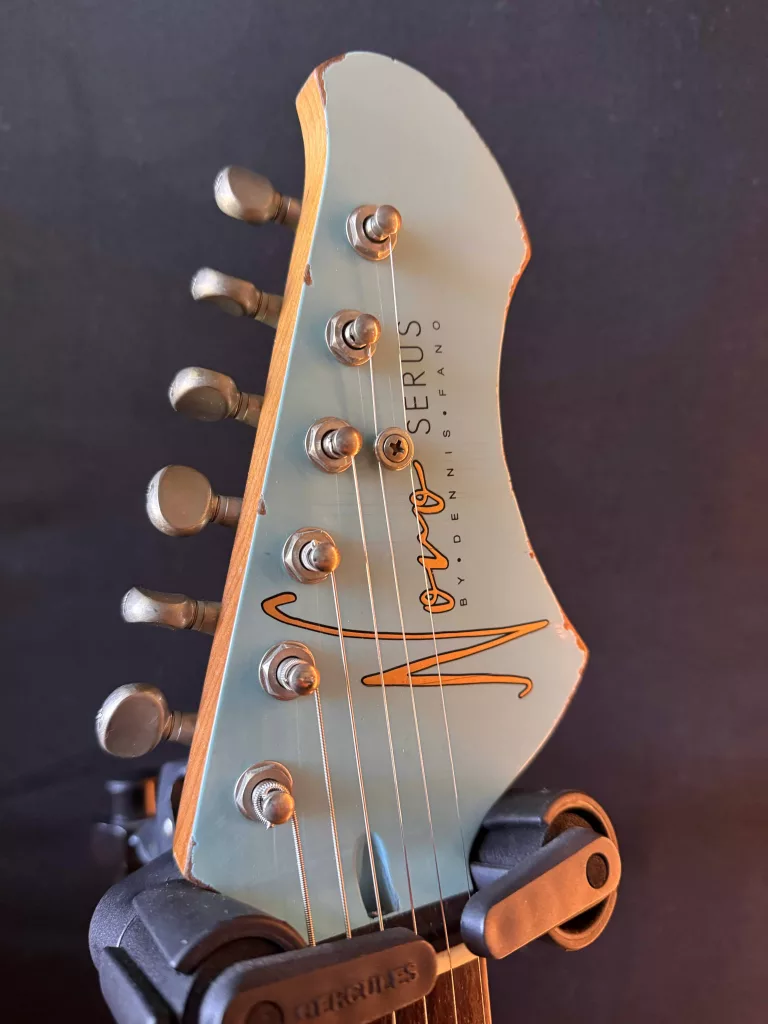
Dennis Fano spent years building guitars under his own name, Fano Guitars, developing a reputation for instruments that looked vintage but played like modern ones. Offset bodies, aged finishes, meticulous fretwork. In 2016, he launched Novo Guitars as a continuation of that work, building out of Nashville with a focus on torrefied tonewoods, boutique hardware, and the kind of attention to detail that boutique builders charge boutique prices for.
The Serus J specifically draws from Jazzmaster DNA: offset body, 25.5” scale, dual P-90s, filtered through Fano’s sensibility. The Mastery M1 bridge replaces the traditional floating Jazzmaster bridge. The NV vibrato is a purpose-built unit with excellent return-to-pitch stability. The Fralin P-90s are wound specifically for this guitar. The torrefied pine body and torrefied maple neck are thermally treated to simulate decades of aging, making them more resonant, lighter, and more stable than untreated wood.
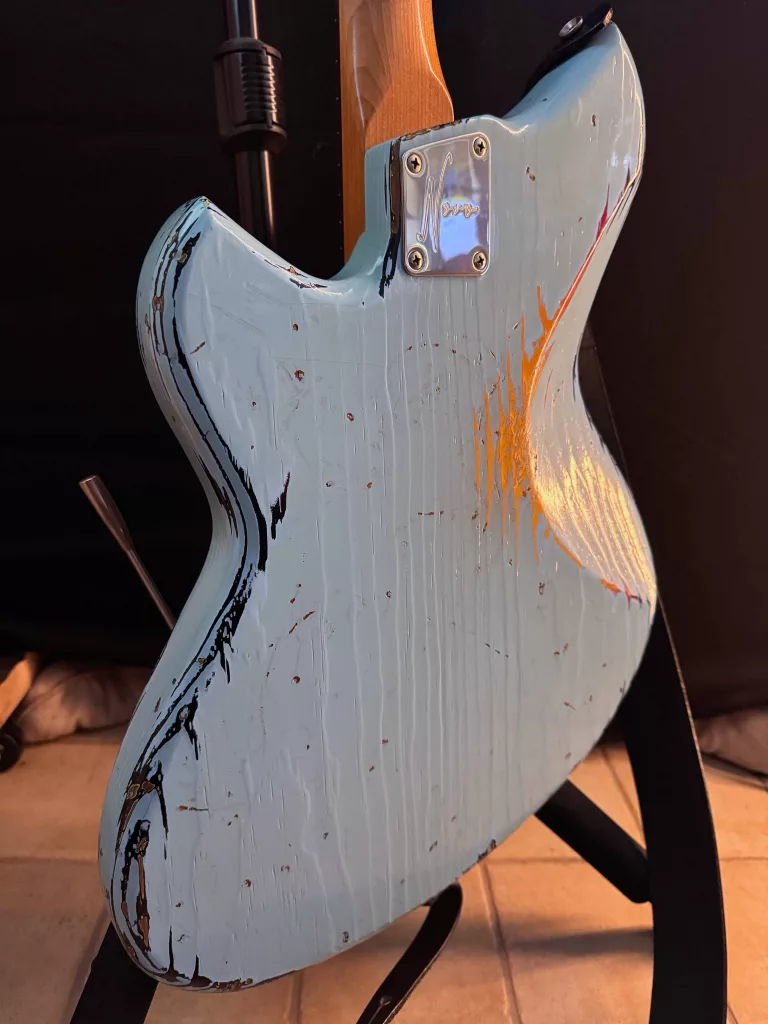
The limited Daphne Blue over ’64 burst finish is exactly what it sounds like. Two finishes. Daphne Blue on top, a sunburst underneath, applied in nitrocellulose lacquer that will thin and wear over time and let the burst bleed through in unpredictable ways. Each one will age differently. Mine already has significant relic work, heavy enough that it looks like it’s been on the road for thirty years.
The Day I Went to N Stuff
As I mentioned at the opening of this blog, I went to N Stuff on a Monday for a routine errand. Make the Ibanez less shreddy. In and out. It was a nice day, the air in western PA was actually warm for a minute, and I had some time to kill, so I walked around N Stuff after dropping off the Ibanez for neutering.
I saw the Novo display and asked if I could hold the Daphne Blue Serus J while I was there. Just to see it. Feel it. Give it a quick strum and see what the buzz is all about.
It Was Big
Bigger than I expected, coming from a lifetime of Strats, PRS, and Gibby SGs. The offset body sits differently, balances differently, and asks something different of you physically from the moment you pick it up. It felt amazing. Everything I’d read, everything I’d watched on YouTube, was spot-on accurate. Sometimes things live up to what people say about them. This was one of those times.
I gave it a quick strum and ran a scale across the neck. Handed it back, said “wow, cool,” and went home. Didn’t think much about it.
Until later that night, when I pulled up that Rhett Shull video again. The one about how he got his Novo. And it started.
The balance, the neck feel, and the way it sat were different from anything I’d played before. Damnit. I knew what was coming.
The Rest Of The Week
The rest of the week, I couldn’t stop thinking about it. I went deep: Dennis Fano, his history with Fano Guitars, why the fanboys flock to Novo, and what they hear that keeps them there. The more I read, the harder it got to talk myself out of it.
Thursday of that week, I bought it. An arm and a leg. Worth it.
And then something happened that I’m still thinking about. The team at N Stuff didn’t thank me. They congratulated me. Not a transactional “thanks for your business” but a genuine acknowledgment that I’d just done something worth celebrating. It was completely about me and the guitar, not about the sale. Nice touch. Great experience.
N Stuff is a longtime family-run store, and it shows in ways that are hard to quantify until you experience them. There’s a culture there of appreciation, of people who genuinely care whether you walk out with the right thing. That matters. In an era where most gear gets bought from a warehouse and shipped to your door, it matters more than most of us stop to acknowledge.
How It Actually Sounds
Let’s be honest about this, because honesty is the only thing that makes gear writing worth reading.
Through my Hiwatt Hi-Gain 50, which I’ve written about elsewhere on this site, my first impression was that something wasn’t quite clicking. The Hiwatt runs warm, dark even, and the Serus J needs room to breathe. I wasn’t sure they were speaking the same language. But I kept at it. Turns out they just needed an introduction. The warmth of the Hiwatt meeting the air and the articulation of the Fralin P-90s produce something so satisfying, gritty, alive, right on the edge of breakup, in a way that makes you not want to stop playing.
Through my ’78 Fender Deluxe Reverb, it sounds good. The Deluxe gives the Fralin P-90s room to do what they do: that combination of snap and warmth, the way they compress slightly when you dig in and open up when you back off. Good. Genuinely good.
Through my ’79 Fender Champ, it sounds amazing. Nothing more to report here. This is the amp for this guitar.
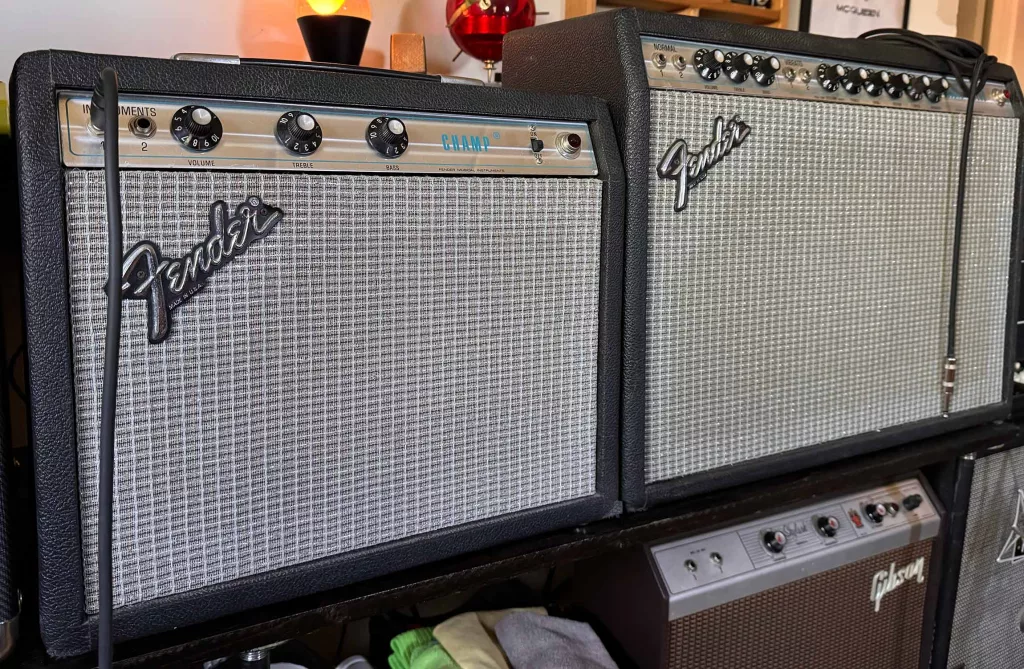
The Amp
I almost sold that Champ to help fund this guitar. I want to sit with that for a moment. The amp that makes this guitar sound its absolute best was thirty seconds away from being listed on Reverb. A small, single-ended, Class A amp running one 6V6 at somewhere between five and six watts, pushing a single eight-inch speaker, built in 1979 when Fender was still making things that lasted. The Fralin P-90s into torrefied pine into that little amp at the edge of breakup is one of the best sounds I’ve heard in my own studio.
Acoustically, the Serus J is remarkable too. Torrefied pine resonates differently than mahogany or alder: lighter, more open, almost piano-like in the way notes sustain and bloom. You can feel the guitar working before it ever hits an amp.
What It’s Doing To My Playing
This is the part I didn’t expect.
I play differently with this guitar in my hands. More arpeggios. More space between notes. Less reliance on chord shapes I’ve been playing for twenty years. I don’t know if that’s the offset ergonomics changing my posture and pick angle, or the P-90 response rewarding a lighter touch, or just the novelty of a new instrument making me listen more carefully. Probably all three.
What I know is that I need to practice with it. That’s not a criticism. It’s the best thing a guitar can do. If it just confirmed everything I already knew how to play, it wouldn’t be adding anything. This one is asking questions I don’t have answers to yet.
For the music I want to make at Down on Jane, layered, psychedelic-adjacent, somewhere between accessible and disorienting, this guitar belongs. The arpeggios through the Champ with some reverb and my Deluxe Reverb’s vibrato in the mix is exactly the kind of sound I’ve been trying to build toward without knowing what it needed.
Was It The Last One?
I think so. I hope so. Probably not.
At a certain point, a collection stops being a collection and starts being inventory. I’m not there yet, but I can see it from here. The Serus J feels like a keeper piece, not because there’s nothing else worth wanting, but because what I have now is coherent. Every guitar has a reason to be there. No redundancy, no guilt, no “I should probably play that more.”
The Martin is sold. The Supro is for sale. The P-90 Strat, the Danelectro, and the Holy Grail Tele are on Reverb.
And the Novo is on its stand next to the Champ, in a studio that also contains a Chucky doll, a vintage Slingerland drum kit, and a life lived around music in the specific way that your forties allow when you’ve stopped apologizing for it.
It’s where I am right now. This is my snapshot in time.