
For years I recorded guitar the way most of us start: one mic, jammed on the grille, done. It worked. But it always felt like I was hearing the amp through a keyhole.
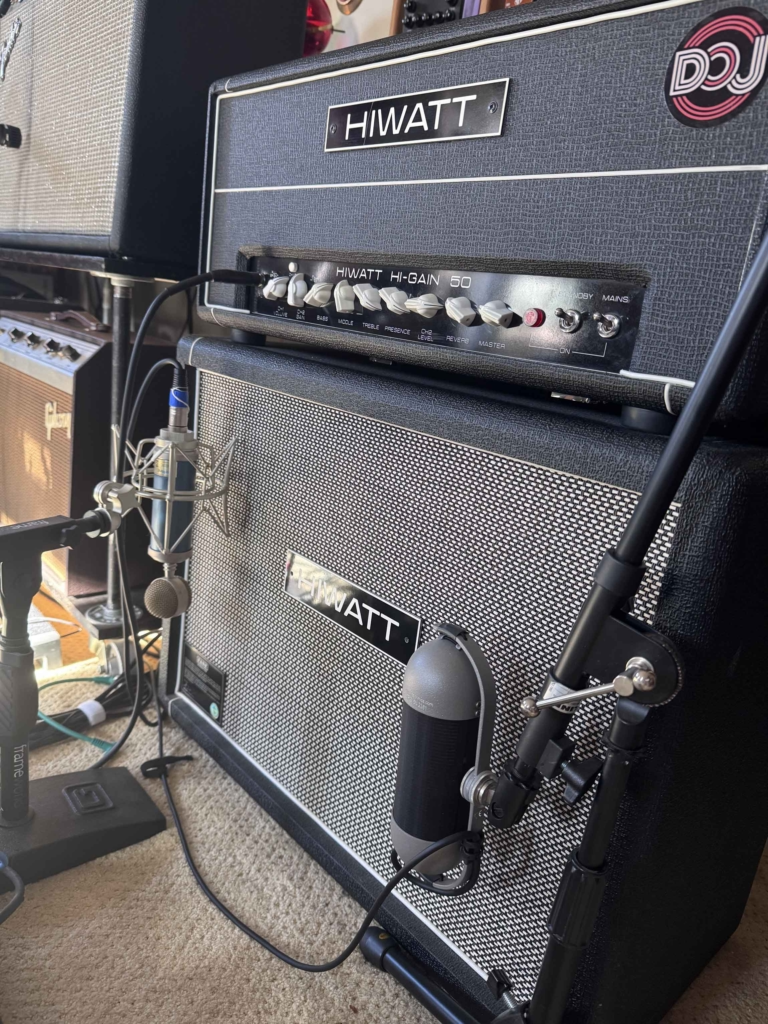
These days I run a Hiwatt Hi-Gain 50 into a matching closed back Hiwatt 2×12 loaded with Fane F75s, and I put two mics on it: an AEA R92 ribbon and a Blue Bluebird SL condenser. Neither one tells the whole story by itself. Together they get me a lot closer to what I hear standing in front of the cab.
Here’s why I landed on this pair, what each one does well, and what I’d add if I wanted the room in the picture too.
Hear it first
Before I get into the why, here’s what it sounds like. I plugged my 1982 Vantage VP-820 into the Hiwatt and played the same part four times:
- Both mics together. This is the sound I actually record with.
- The AEA R92 alone. Listen for the weight in the low mids and how smooth the top end is. It’s big, but a little dark on its own.
- The Bluebird alone. Listen for the pick attack and string detail. It’s clear and cutting, but thinner, with more edge from the Fanes.
- Both again. After hearing them separately, notice how the blend keeps the body of the ribbon and the clarity of the condenser.
If you only listen on phone speakers, the differences are subtle. Headphones or decent monitors make it obvious.
Start with the cab, not the mics
Mic choice only makes sense once you know what the speaker is putting out. So let’s talk about the cab first.
The Fane F75 is a 75 watt, English made 12 that Fane builds exclusively for Hiwatt, designed to replace the speakers in the classic Hiwatt 4123 cabs (Hiwatt via Reverb). Hiwatt actually redesigned the modern Fane to chase the tone of the original early 70s Hiwatt Fanes, because the stock high wattage version sounded too hard (Legendary Tones).
What that means in practice:
- Clean, detailed midrange. The F75 is known for mids that cut through a mix without needing a ton of volume (Sonovente).
- Headroom with bite. It stays clean longer than a lot of British speakers, but when it breaks up it has real snarl in the upper mids.
- A bright, forward top end. Great in a room. Put a bright mic right on it, though, and that bite can turn into fizz fast, especially with a fuzz or a high gain channel.
The closed back matters too. With no open back, the cab projects almost everything forward and the low end stays tight and focused. That punch is part of the Hiwatt sound, but it also means close mics hear a lot of low end bouncing around inside that sealed box. You have to pick mics that can handle that without turning to mud.
So the job is clear: keep the punch, keep the mids, and tame the top without losing the clarity Hiwatt is famous for. That’s where the two mics come in.
The AEA R92: the body and the weight
The R92 is the mic that makes the cab sound big. If I could only keep one, this is it.
It was built for exactly this job. Most vintage ribbons are voiced for a few feet back, because up close their proximity effect piles on so much low end it buries the mids. AEA designed the R92 to be used close, and it was literally developed because some guitar playing AEA employees wanted a ribbon that sounded great right up against the grille (Tape Op). AEA says it’s meant to live between 1 and 18 inches from the source (AEA).
Reduced proximity effect. This is the big one with a closed back cab. A regular ribbon a couple inches off a sealed 2×12 gets boomy and woolly. The R92 keeps the low end thick but controlled, so the punch of the cab stays punchy instead of muddy.
A smooth top end. Ribbons naturally roll off the highs in a gentle, musical way. On a bright, bitey speaker like the F75, that’s exactly what you want. The fizz on top of a fuzz or a cranked Hiwatt gets rounded off before it ever hits the preamp, and you don’t have to fight it with EQ later.
Thick low mids. AEA describes it as having a thick low end and a hefty midrange (AEA). That’s where big open chords live. As a rhythm player who loves chunky chords and sustain, this is where my tone actually is.
Two mics in one. The R92 is a figure 8, and the front and back sides sound different (AEA). Flipping it around is a quick tone control before you ever touch an EQ, so try both sides and pick the one that suits the part.
How I place it: a few inches off the grille, roughly between the dust cap and the edge of the cone, then I move it an inch at a time while listening. Two practical notes. It’s passive, so it needs a preamp with plenty of clean gain. And I keep phantom power off that channel, just to be safe with a ribbon.
The Blue Bluebird SL: the cut and the detail
If the R92 is the body, the Bluebird is the edge. On its own it can be a little much on a bright cab. Tucked under the ribbon, it’s what lets the guitar speak in a mix.
Detail up top. The Bluebird is a large diaphragm condenser with extended upper clarity and smooth mids (Adorama). It catches pick attack, string definition, and the little bit of air coming off the speaker that the ribbon smooths over. That’s the stuff that keeps a dense rhythm part from turning into a wall of mush.
It can take the volume. A condenser two inches from a 50 watt Hiwatt sounds like a bad idea until you check the numbers. The Bluebird SL handles 138 dB SPL and has a switchable -20 dB pad (B&H). I hit the pad when the amp is really moving air so the mic’s electronics never get pushed into ugly distortion.
A built in high pass filter. It has a 100 Hz, 12 dB per octave low cut (B&H). With a closed back cab, that’s handy. The R92 is already handling the low end, so I can let the Bluebird focus on mids and highs and keep the two from stacking up boom on top of boom.
Cardioid focus. Being cardioid, it mostly hears what’s in front of it and less of the room (B&H). Close on a cab, that keeps it about the speaker.
How I place it: right next to the R92, same distance from the grille, angled a touch toward the center of the cone if I want more bite or toward the edge if the F75s are getting spiky. Small moves make a big difference here.
Why two mics beat one
Each mic covers the other’s weak spot. The R92 alone can get a little dark and polite. The Bluebird alone can get bright and thin on this cab. Blended, I get weight and clarity at the same time.
I usually start with the R92 as the main voice and bring the Bluebird up underneath until the guitar starts to jump out of the speakers. Then I stop. Most of the time the ribbon ends up a bit louder.
The one thing you can’t skip: phase. Two mics on one speaker only work if they’re hearing it at the same moment. If they aren’t, certain frequencies cancel and the tone goes hollow and thin.
- Put both capsules the same distance from the grille, side by side, as close together as you can.
- Record a few seconds of chunky chords and listen to both mics together in mono.
- Flip the polarity on one channel. Whichever setting sounds fuller and louder in the low mids is the right one.
- Still a little hollow? Nudge one mic forward or back a half inch, or zoom in and line up the waveforms in your DAW.
A figure 8 ribbon and a cardioid condenser don’t always agree on polarity right out of the gate, so step 3 is worth doing every single time you set up.
If I added a room mic
The R92 and Bluebird are both close mics. They capture the speaker. What they don’t capture is the cab moving air in a real space, the thing you feel standing in front of a loud amp. A room mic adds that.
My pick: an AKG C414 XLS set to omni. Here’s why.

- Omni hears the room evenly. The close mics are already directional and focused. The room mic’s job is the opposite, so I want a pattern that picks up reflections from every direction.
- Multiple patterns to experiment with. The 414 lets me switch to figure 8 or cardioid if the room sounds too washy in omni. In a home studio that flexibility matters.
- The XLS is the flatter, more neutral version. Its sibling, the XLII, has a presence boost. On top of bright F75s and the Bluebird’s detail, I don’t need more top end. I want the room mic to add space, not more sizzle.
If I wanted something darker and more vintage, a big far field ribbon like an AEA R84 would be my second choice. It would make the room sound warm and huge, but it would also stack more ribbon character on top of the R92.
How far back? In a typical home studio, start about 4 to 6 feet from the cab, roughly at chest height, pointed at the speakers. If the room is bigger, try up to 8 to 10 feet. Avoid parking it dead center in the room or right up against a wall, where low end builds up.
What distance actually does. Sound travels roughly a foot per millisecond. So a mic 6 feet back hears the cab about 5 or 6 milliseconds after the close mics do. That small delay is the whole point:
- Closer (3 to 5 feet): more cab, a little room. Adds thickness and a sense of size without obvious ambience.
- Further (6 to 10 feet): more room, less direct sound. The guitar gets depth and sits back in the mix. Push the fader too far and it turns washy or slightly smeared.
I’d still check polarity on the room mic against the close pair, the same way as above, but I wouldn’t time align it. Line it up perfectly and you lose the depth you put it there for.
One honest note: my studio is fully treated, so the room itself is pretty dead. A room mic in a treated space adds size and air more than obvious reverb. In a livelier room, like a basement with concrete walls, it would do a lot more.
The real lesson
None of this is about owning the fanciest mics. It’s about listening to what your cab actually does and picking tools that fill in the gaps. For me, that’s a ribbon for weight, a condenser for cut, and maybe someday a room mic for size.
The best way to learn it is the same way I did: put up two mics, flip some switches, move things an inch, and trust your ears. Then go play something.